
Think about if nobody on the planet may agree on what time it’s, the place one particular person says it’s 3:00 PM, one other says it’s 3:02 PM, and another person thinks it’s nonetheless lunchtime. In the actual world, we’ve got clocks, telephones, and the web to assist us keep in sync, however on the planet of Web3, the place computer systems run code with none central authority, setting the clock turns into a a lot larger deal.
So, who units the clock in Web3? Let’s dive into the world of decentralized timekeeping and see why it’s essential, the way it works, and what makes it difficult.
What’s Timekeeping and Why Does it Matter?
Timekeeping is solely protecting monitor of time. In regular life, time tells us when to get up, go to high school, eat dinner, or watch our favorite exhibits. For computer systems and networks, time can also be fairly essential.
In Web3 and blockchain, time helps determine:
When a transaction occurredWhen a wise contract ought to runWhen a reward needs to be givenWhen a recreation transfer is allowed
If everybody’s clock is completely different, many issues may go flawed: a contract would possibly run too early, a reward could be delayed, or somebody may cheat the system. That’s why decentralized timekeeping is so essential. It ensures that we’re protecting monitor of time with out trusting only one clock, particular person, or central authority.
Centralized vs Decentralized Time
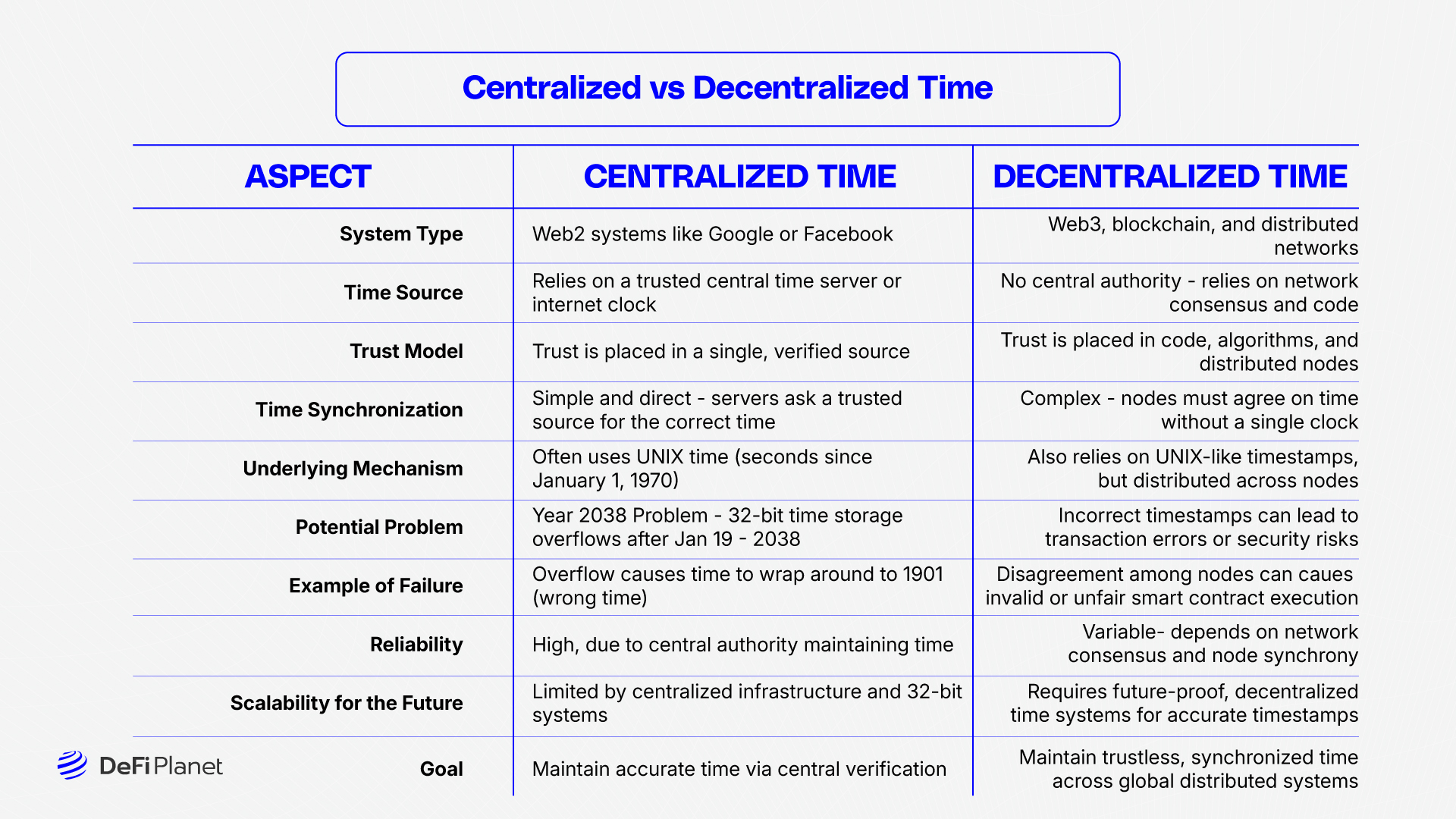
Within the outdated Web2 world (like apps run by Google or Fb), servers simply ask a trusted time supply, like a time server or an web clock, and get the right time. This was fairly easy, however in Web3, there’s no central server, and every little thing is constructed on trustless techniques, which implies folks don’t must belief one another. As a substitute, they belief the code and the community, and this, for one, makes protecting time a lot more durable. If we are able to’t belief a single clock, how can we be sure all nodes (computer systems within the community) agree on the identical time?
Most laptop techniques (like UNIX, which many servers use) hold monitor of time by counting the variety of seconds since a particular place to begin: January 1, 1970, and that is known as the UNIX epoch; as a substitute of storing the precise date, the pc shops only a quantity like “17,000,000,000 seconds since 1970.” This quantity is saved in a binary format (1s and 0s), and the variety of bits used decides how excessive it could possibly depend, with older techniques utilizing 32-bit integers to retailer this time.
Right here’s the place the issue is available in: a 32-bit signed integer can solely depend as much as 2,147,483,647 seconds and for those who convert that variety of seconds right into a calendar date, you get January 19, 2038, after that date, the quantity overflows; that means it could possibly’t depend up anymore and wraps round to a unfavorable quantity, which computer systems interpret as a time in 1901! That is known as the Yr 2038 downside, just like the Y2K bug that scared folks in 1999.
In decentralized timekeeping, we are able to’t threat everybody’s clocks breaking or displaying the flawed time, primarily since blockchain timestamps, good contract timing, and trustless techniques all depend on correct clocks. If the bottom timekeeping breaks, it could possibly result in incorrect transactions, unfair rewards, or safety issues, and that’s the reason Web3 infrastructure must be constructed on future-proof techniques. And a part of which means upgrading the best way we monitor and retailer time.
How Blockchains Monitor Time
Most blockchains don’t have a daily clock and as a substitute use blockchain timestamps. These timestamps are added to every block (a bunch of transactions) when it’s created. This manner, folks can know the order of transactions. For instance, if Alice had been to ship Bob 1 ETH earlier than Bob sends 1 ETH again, the blockchain can show it as a result of the blocks will present the right order, however right here’s the twist: these blockchain timestamps should not at all times excellent. They rely upon the node that creates the block, and typically completely different nodes have barely completely different instances.
Consensus Time: Agreeing on the Clock
To repair the time downside, blockchains use one thing known as consensus time: a approach for all of the nodes within the community to agree on what time it’s, even when their native clocks are a bit completely different. Let’s say 100 nodes are creating blocks, and every block comes with a timestamp. The community checks if that timestamp is inside a standard vary (not too far previously or future), and if it’s too flawed, the block is rejected. This retains everybody in sync, even when their clocks are a number of seconds off.
Consensus time is like when a bunch of mates decides to fulfill at “round 5 PM.” Even when one particular person is a couple of minutes late, all of them agree on the final time.
Good Contracts and Timing
Good contract timing is among the most essential elements of decentralized timekeeping. Good contracts are items of code that dwell on the blockchain and run mechanically when situations are met.
Some contracts want to attend till a sure time to run. For instance:
A lottery that ends at midnightA mortgage that have to be repaid in 30 daysA recreation that permits strikes each 10 minutes
If somebody may change the time, they might cheat, and that is why contracts depend on blockchain timestamps and consensus time to know when to behave, however what if a wise contract wants the precise time? That is the place time oracles are available in.
What Are Time Oracles?
Blockchains can’t test the actual world on their very own as they have no idea the climate, inventory costs, and even the present time out of your telephone. That’s why we’ve got oracles, that are particular companies that deliver exterior data into the blockchain.
A time oracle is a instrument that provides correct time to good contracts; it could possibly inform the contract what time it’s, and the contract can then act primarily based on that data. However right here’s the tough half: oracles have to be reliable, and if somebody hacks the oracle or offers faux time, they might mess up the entire system.
Because of this good Web3 infrastructure consists of secure and verified time oracles that many nodes can belief.
The Menace of Temporal Manipulation
One massive downside is temporal manipulation, when somebody tries to alter or lie in regards to the time. Let’s say a miner needs to earn extra rewards. They may attempt to set their blockchain timestamps a number of seconds previously or future to make it appear like their block was first. Or they might delay their block simply sufficient to cheat in a recreation or public sale.
Whereas networks attempt to cease this utilizing consensus time, it’s nonetheless not excellent. That’s why researchers are at all times in search of higher methods to guard Web3 from time cheats.
Constructing Higher Web3 Infrastructure
To unravel these issues, builders are constructing stronger Web3 infrastructure that features higher instruments for monitoring time.
Listed here are a number of concepts getting used or examined:
Multi-source time oracles: As a substitute of 1 time supply, use a number of and take the common.Trusted execution environments (TEEs): Safe laptop elements that present a dependable time.Verifiable delay capabilities (VDFs): Mathematical methods to show how a lot time has handed.Decentralized clock networks: Entire new techniques constructed simply to supply trusted time.
These instruments goal to make sure decentralized timekeeping is secure, correct, and honest.
Why Decentralized Timekeeping Issues for the Future
You could be questioning, “Why ought to I care about this?” The rationale it issues is that as Web3 continues to develop, it’s turning into the muse for a lot of issues we use and rely upon, from digital cash and on-line video games to how we vote or monitor merchandise in a retailer. These techniques aren’t simply enjoyable experiments; they’re being constructed to deal with real-life duties that require accuracy and safety. And all of them rely upon one essential factor: time.
With out dependable good contract timing, these techniques can’t work correctly. Time tells a wise contract when to unlock a cost, when a recreation ought to finish, when a vote needs to be counted, or when a supply is late. If the time is flawed or somebody can change it unfairly, the entire system falls aside. Somebody may trick the system to win after they shouldn’t, take cash they didn’t earn, and even affect essential choices, comparable to the end result of a vote. These aren’t simply minor points; they might hurt folks and erode belief in the whole Web3 house.
That’s why decentralized timekeeping is so essential, as a result of it protects everybody by ensuring nobody can management or faux time for their very own achieve. In trustless techniques, the place no single particular person or group is in cost, time have to be agreed upon by the whole community. This helps hold every little thing sincere and functioning because it ought to. As extra of our day by day lives transfer onto blockchains, having a good and safe strategy to monitor time isn’t simply helpful; it’s completely essential. With out it, Web3 couldn’t work the best way it guarantees to: open, honest, and for everybody.
Last Ideas: Who Units the Clock?
So, again to our query: who units the clock in Web3?
The reply is each easy and complicated, everybody and nobody. There isn’t a single grasp clock or central timekeeper. As a substitute, Web3 depends on a mixture of techniques working collectively. The community agrees on the time utilizing one thing known as consensus time, and every block on the blockchain carries its personal blockchain timestamp. Good contracts are written with built-in timing guidelines, and time oracles assist feed correct time from exterior sources into the blockchain. All of that is doable because of a powerful and evolving Web3 infrastructure, which is designed to assist these trustless techniques.
Somewhat than being managed by anybody firm or authorities, time in Web3 is managed by the very folks and machines that hold the blockchain alive, and that’s what makes it decentralized timekeeping: a system the place time belongs to the whole group. Whereas it’s nonetheless being improved, it’s already proving to be an essential a part of how Web3 works. As Web3 turns into extra widespread in our on a regular basis lives, we’ll depend on these shared techniques increasingly to maintain every little thing in sync.
Disclaimer: This text is meant solely for informational functions and shouldn’t be thought of buying and selling or funding recommendation. Nothing herein needs to be construed as monetary, authorized, or tax recommendation. Buying and selling or investing in cryptocurrencies carries a substantial threat of economic loss. All the time conduct due diligence.
If you wish to learn extra market analyses like this one, go to DeFi Planet and comply with us on Twitter, LinkedIn, Fb, Instagram, and CoinMarketCap Neighborhood.
Take management of your crypto portfolio with MARKETS PRO, DeFi Planet’s suite of analytics instruments.”