
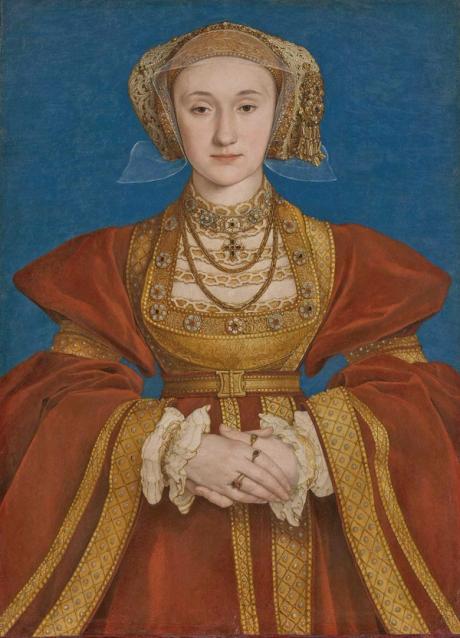
Take into account Hans Holbein the Youthful’s portrait of Henry VIII’s fourth spouse, Anne of Cleves: an enigmatic look, solid from beneath heavy-lidded eyes; a protracted nostril, the tender breath from which is nearly felt; a crimson velvet robe richly adorned with gold and pearls, set in opposition to a blue background made extra vivid by its current restoration. Serving as the quilt picture for Elizabeth Goldring’s biography, it’s a portray that conveys a lot of her topic’s persevering with fascination: the eye-popping persuasiveness of his work; its potential to outline an period in our cultural reminiscence, and its enduring mysteriousness. For regardless of all their obvious credibility, Holbein’s sitters stay surprisingly alien, plucked from a previous we will by no means correctly know.
Goldring is the newest in a line of biographers and artwork historians who’ve tried to excavate that previous. In so doing, she has taken the time period “biographer” actually. This 424-page tome is an examination of Holbein’s life (1497/8-1543), and although generously illustrated, the writer declines to indulge her readers in an excessive amount of pictorial interpretation. Neither Holbein’s visible conceits, nor his deployment of symbolism, are Goldring’s explicit curiosity. She alludes solely frivolously to the progressive beats his works have made throughout the story of artwork: be {that a} close to unmatched stage of verisimilitude in his portraiture; an unprecedented diploma of archaeological authenticity in his ground-breaking Useless Christ within the Tomb (1521-22, Kunstmuseum Basel); or an exploration of the science of perspective that, although most famously evident within the anamorphic cranium in The Ambassadors (1533, Nationwide Gallery, London), is explored all through his profession.
As an alternative, Goldring’s focus, and nice energy, is her scholastic potential to interrogate the documentary proof that informs the manufacturing of Holbein’s work, utilizing it to unpick the the place and the when, and to appropriate or qualify assertions which have lengthy gone unchallenged.
The ebook is structured chronologically, with every chapter subdivided into a number of key biographical moments. Inside this user-friendly text-book strategy, Goldring’s in depth, devoted and sometimes granular detective work throws up new theories, substantiates assumptions and contributes to the continued debate.
She comes into her personal when coping with the second half of Holbein’s profession, whereas he was on the Tudor court docket of Henry VIII. For instance, she has delved into the royal palace of Westminster’s inventories and found that the court docket chambers of the Duchy of Lancaster have been adorned with inexperienced cloth. With this element she will be able to now counsel that the inexperienced curtain Holbein has included within the 1527 portrait of Sir Thomas Extra (Frick Assortment, New York), might point out that it was painted to have fun the sitter’s newly acquired standing as chancellor of that duchy.
Unearthing new proof
In the meantime Goldring goes to appreciable lengths to show the belief held by many students that Extra would have had a number of copies product of the Frick portrait kind. Her analysis has led her to a different model, now situated in Crosby Moran Corridor in London, that “might have been executed throughout Holbein’s lifetime”. She strikes on to assemble proof for single portraits taken from sketches of different sitters, which have been likewise used for the misplaced portray of Thomas Extra and his Household (additionally courting to 1527). As well as, her re-examination of correspondence written in Latin between the Extra household and the Dutch humanist Erasmus, the place the latter describes his pleasure at receiving the reward of a pittura (portray) by Holbein of its members, reasonably than a figura (the time period that may usually relate to a drawing) prompts Goldring to counsel that the artist introduced Erasmus with a smaller-scale (additionally misplaced) portray of the above-mentioned household portrait. With such shut consideration to the element, she has maybe answered a conundrum that has confounded different writers (together with this one), who’ve too simply assumed that Holbein introduced Erasmus with a drawing of the household, probably the instance now situated within the Kunstmuseum Basel.
Goldring additionally dives into ongoing Holbein debates the place documentary proof will not be forthcoming. In these situations, her conjecture stays intriguing, albeit not all the time extra convincing than different theories in circulation. Her hypothesis {that a} miniature of an unknown woman—variations of that are within the British Royal Assortment and Buccleuch Assortment—could also be Jane Seymour’s sister Elizabeth Seymour-Cromwell is a considerate addition to an inventory of advised sitters that features Anne of Cleves (this writer’s proposal), and Katherine Howard.
On a stylistic observe, Goldring’s educational warning is writ giant, with the impact of undermining her evident authority. Her continuous have to qualify a lot of her considering with “maybe”, to preface it with “one can’t know”, or state that one thing is just “most likely” the case, although after all true, however results in a barely unsettling studying expertise over the period of so many pages. This scholastic humility offers the cumulative impact that Goldring raises extra questions than she solutions. That is significantly irritating provided that she solutions an excellent deal.
• Elizabeth Goldring, Holbein: Renaissance Grasp, Paul Mellon Centre, 424pp, 250 color illustrations, £40 (hb), printed 11 November 2025
• Franny Moyle is the writer of The King’s Painter: The Life and Instances of Hans Holbein and Mrs Kauffman & Madame Le Brun (2021 and 2025, each Head of Zeus)